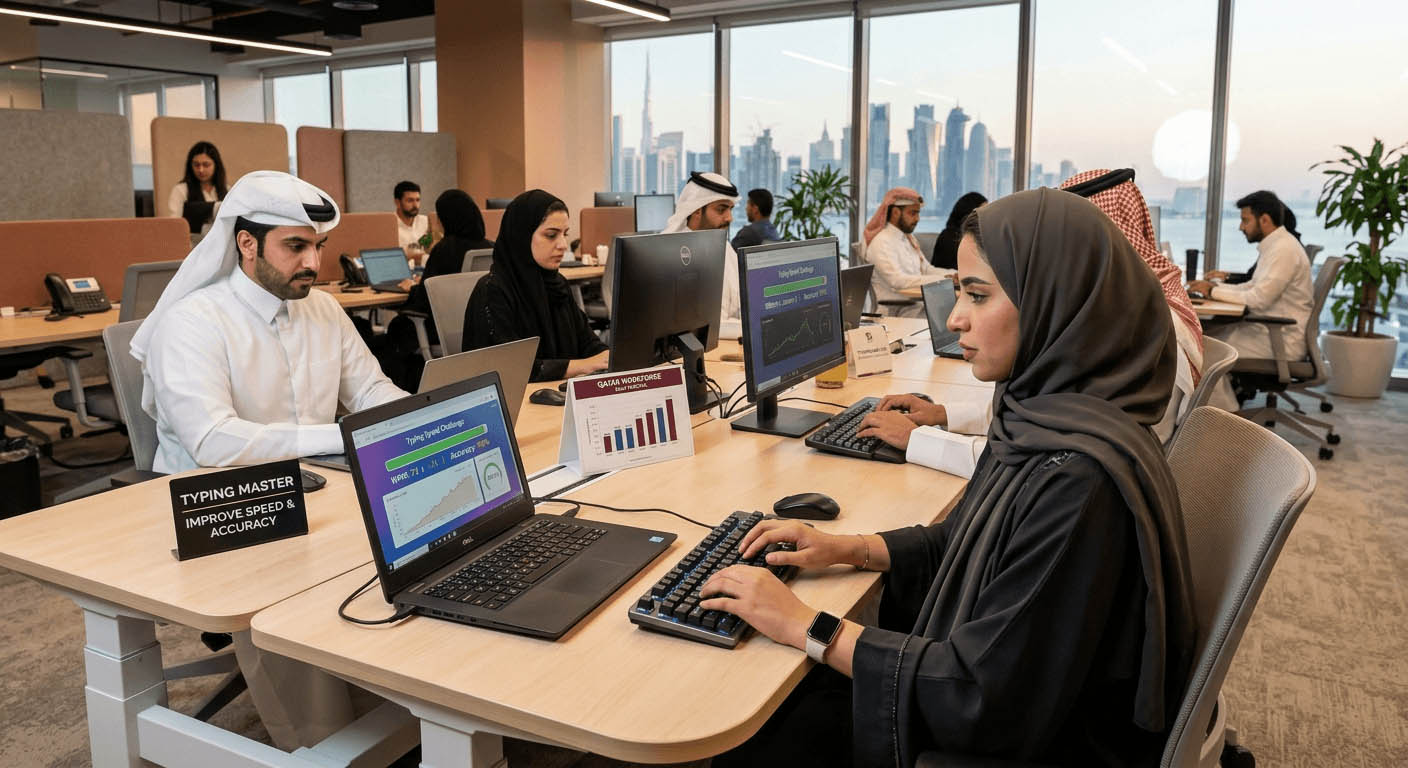
Most office workers in Qatar have sent thousands of emails without once stopping to wonder how fast they actually type. Between Arabic subject lines, English report bodies, and back-and-forth Teams messages with colleagues across three time zones, the fingers are always moving. But moving fast and moving efficiently are two very different things. A growing number of expats and local professionals here are figuring that out, and they are doing something about it.
- The average office worker types between 38 and 45 WPM, well below what most job roles actually demand.
- Bilingual professionals in Qatar often lose extra seconds switching between Arabic and English inputs.
- Structured typing practice, not random daily use, is what closes the gap fastest.
- Remote workers in Qatar are leading the shift toward intentional keyboard skills.
The Reality of Typing in a Bilingual Work Environment
Qatar’s professional landscape is genuinely unique. Walk into any mid-size company in West Bay or the Pearl and you will find teams communicating in English, Arabic, and sometimes a third language all within the same working hour. That constant mental switching has a real cost. It slows down the fingers even when the mind knows exactly what to say.
For expats, the challenge is slightly different. Many are typing entirely in English but still feel the drag. Their typing habits were formed on old keyboards in university libraries or from messaging friends on a phone. Those habits carried over into the workplace and nobody ever corrected them. Two-finger typists exist at every seniority level. Some of them manage entire departments.
The problem compounds with Qatar’s email culture. Formal communication here tends to be longer and more detailed than in some Western markets. A reply that might be three lines in London becomes a full paragraph in Doha. That means more keystrokes, more time, and more room for the gap between a slow typist and a fast one to become visible.
Why Most Professionals Have Never Measured Their Own Output
Here is a simple truth: most people assume they type fine. They have been doing it for years. It feels natural. But feeling natural and being efficient are not the same thing.
Typing speed is one of the few professional skills that almost never gets formally assessed after school. A candidate’s qualifications, language ability, and industry knowledge all get scrutinized in interviews. Their words-per-minute rate almost never comes up. So professionals go years without a real picture of where they stand.
That changes the moment someone actually runs a test. Checking typing speed benchmarks for the first time is often a genuine surprise. Some people discover they are faster than average. Many find they are not. A finance professional expecting to clock 60 WPM and landing at 39 is a common scenario, and it tends to be motivating rather than discouraging.
The benchmarks also break down performance by job role, which matters more than a single general average. An administrative coordinator has different needs than a software developer. A legal secretary working for a Doha law firm with heavy document drafting requirements has different needs again. Seeing your score in context makes the information actionable.
What the Numbers Actually Mean for Office Output
A difference of 15 words per minute might sound small. Run the math across a full working day and it starts to look very different.
Consider an office professional who types for a focused three hours each day. That is a conservative estimate for anyone in a communications-heavy role. At 40 WPM, they produce around 7,200 words of typed output. At 55 WPM, that same three hours produces close to 9,900 words. That is nearly 2,700 more words of emails, reports, proposals, and messages with no extra time invested.
Across a year, the compounding effect is significant. Faster typists finish email threads earlier. They respond to clients before competitors do. They produce draft reports in one sitting instead of two. In Qatar’s fast-moving sectors, including finance, hospitality, oil and gas administration, and real estate, that margin adds up.
Daily Typed Output by WPM (3 Hours Active Typing)
35 WPM
6,300
45 WPM
8,100
55 WPM
9,900
70 WPM
12,600
The Habits That Are Actually Slowing People Down
Bad typing habits tend to be invisible to the person who has them. They feel normal because they have been reinforced for years. But they are costing time every single day.
Here are the most common patterns spotted in Qatar’s office environments:
- Looking at the keyboard constantly. This adds a mental step between thinking and typing. The eyes should be on the screen, tracking what is being produced.
- Using only two or three fingers. The hunt-and-peck method maxes out around 40 WPM for most people. It is a ceiling that cannot be broken without changing the technique entirely.
- Typing in bursts with long pauses. Some professionals type quickly in short bursts and then stop to think with hands off the keyboard entirely. Rhythm matters more than peak speed.
- Inconsistent finger positioning. Not anchoring to the home row means every keystroke involves extra hand travel. Small inefficiencies become large ones at scale.
- No dedicated practice time. Typing only during actual work tasks keeps you at your current level. Improvement requires deliberate repetition outside of live work pressure.
How Qatar-Based Remote Workers Are Closing the Gap
The remote work shift that accelerated globally has had a specific effect in Qatar. Professionals working from home in Lusail, Al Waab, or Madinat Khalifa are suddenly more aware of their output because the feedback loop is tighter. There is no walking to a colleague’s desk. Every communication is typed. The keyboard has become the primary interface between a remote worker and their entire professional world.
That awareness is pushing more people toward structured self-improvement. The approach that keeps coming up is committing to touch typing lessons as a proper skill to develop, not something picked up casually. Touch typing means all ten fingers have assigned positions and responsibilities. The hands barely need to move. Accuracy increases. Speed follows.
What makes the method particularly effective for bilingual typists is that it separates muscle memory from conscious thought. Once the fingers know where the letters are without looking, switching between English content and bilingual formatting becomes far less disruptive to overall flow.
Building a Typing Practice Routine That Actually Sticks
Improvement does not require hours of daily drilling. Consistency beats intensity for this kind of motor skill development. Here is what a realistic routine looks like for a working professional:
- Fifteen to twenty minutes of focused practice each morning before opening email.
- Starting at a speed that feels slightly uncomfortable but still allows accuracy above 95 percent.
- Tracking WPM weekly rather than daily to see genuine trend lines instead of daily fluctuation.
- Accepting a temporary dip in speed when switching to correct technique. This phase passes within two to three weeks.
- Practicing on content similar to real work: professional sentences, technical vocabulary, mixed-case text.
The first two weeks of changing technique tend to feel frustrating. Professionals who were typing at 45 WPM with poor habits may drop to 30 WPM while retraining their fingers. That is normal and expected. The ceiling they can eventually reach after a month of deliberate practice typically surpasses their old plateau by a wide margin.
Job Roles Where Speed Gains Matter Most in Qatar
Administrative and Executive Support
PAs and executive assistants in Qatar often manage correspondence for senior staff in addition to their own. Higher typing speed translates directly into time that can be redirected toward higher-value tasks.
Finance and Accounting Teams
Report drafting, client communication, and regulatory filings involve dense text output. A finance professional typing at 60 WPM versus 40 WPM produces reports noticeably faster with less end-of-day fatigue.
HR and Recruitment
Qatar’s HR sector handles enormous volumes of communication, especially during peak hiring seasons. Offer letters, rejection emails, interview scheduling, and onboarding documentation all pass through keyboards. Speed and accuracy here reduce errors and turnaround time simultaneously.
Media and Communications
Journalists, content creators, and PR professionals working in Doha’s growing media sector have perhaps the most direct relationship between typing speed and professional output. Every additional WPM is a line of copy that reaches an editor faster.
Your Keyboard Skills Are a Career Asset Worth Measuring
Typing is one of the rare skills that crosses every industry, every job title, and every stage of a career. It does not belong to one department or one type of worker. It belongs to anyone who uses a computer to do their job, which in Qatar’s professional landscape is nearly everyone.
The professionals getting ahead of this are not treating it as a nice-to-have. They are treating it as a measurable, improvable skill, the same way they would treat their presentation ability or their knowledge of a second language. They tested themselves, saw where they stood, and took a structured path toward something better.
That path is available to anyone. It starts with knowing your number. From there, the only question is whether you want to change it.