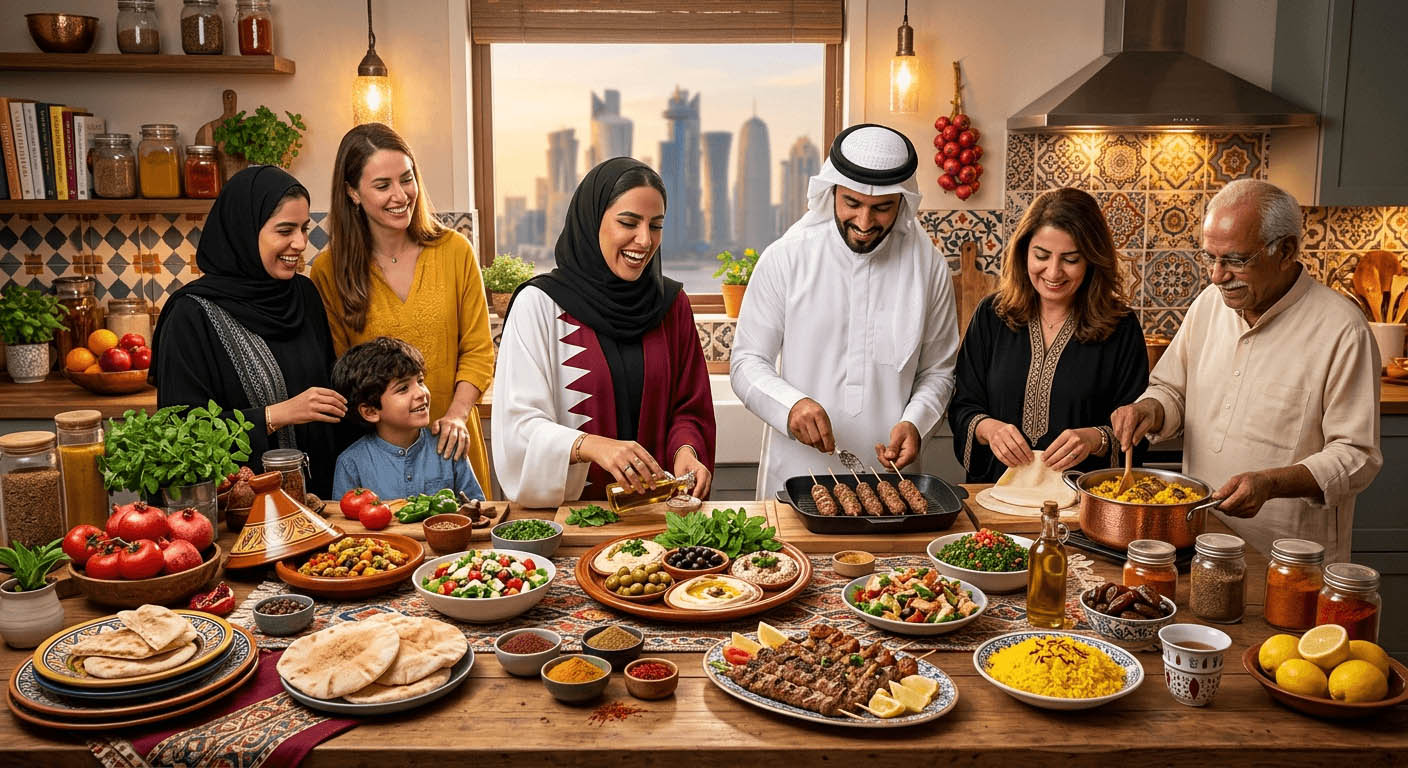
Walk into a Doha home on a Friday afternoon and you might find a Jordanian family pressing fresh tabouleh while the smell of Indian curry drifts in from the apartment next door. Qatar holds people from dozens of countries, and food is how those cultures meet, share, and understand each other. Mediterranean cooking, with its emphasis on fresh herbs, grilled proteins, olive oil, and shared plates, drops into that setting like it was always meant to be there.
At a Glance: Why This Works
- Qatar’s large Levantine expat community already cooks half of these dishes from memory
- Communal dining is the default in Qatar, and Mediterranean food is built for exactly that
- Fresh, herb-forward flavors work well in a climate where people crave lighter but satisfying food
- JustHere.qa covers the cultural context that makes cooking in Qatar feel grounded and informed
- Both Eid feasts and casual weekday meals benefit from these accessible, crowd-pleasing recipes
The Cultural Overlap That Makes This More Than a Trend
Qatar is home to one of the largest concentrations of Levantine expats in the Gulf. Lebanese, Syrian, Jordanian, and Palestinian communities have been part of Doha’s fabric for decades. For them, Mediterranean food is not foreign. It is family cooking. Hummus, baba ghanoush, kibbeh, manakish, grilled lamb with garlic sauce. These are dishes that appeared on their grandmothers’ tables.
For expats from other parts of the world, the flavors feel approachable. There is nothing aggressive or unfamiliar about good olive oil, lemon, garlic, and fresh parsley. These are ingredients that translate across cultures without losing anything in translation.
JustHere.qa captures this layered reality well. The platform understands that cooking in Qatar is never a single-culture activity. It is always a negotiation between where you came from and where you live now.
Mediterranean flavors, rooted in community
What Mezze Teaches Us About Eating Together
Qatar’s dining culture has always been generous. Large tables, multiple dishes arriving at once, nobody eating alone. That is a near-perfect match for how Mediterranean food is meant to be served.
Mezze is not a starter in the Western sense. It is a philosophy. You put out six or eight small dishes and everyone reaches, shares, tears bread, and talks. That rhythm feels completely natural in Doha, where hospitality is not just expected. It is a cultural obligation.
Here are some of the mezze staples that work beautifully in a Qatar kitchen:
- Hummus with warm flatbread – simple, crowd-pleasing, endlessly adaptable
- Fattoush salad – bright, crunchy, and made from ingredients available at any Doha supermarket
- Baba ghanoush – charred eggplant with tahini, a staple across Levantine and broader Mediterranean tables
- Labneh with za’atar and olive oil – three ingredients, zero effort, maximum result
- Stuffed grape leaves (warak dawali) – labor-intensive but absolutely worth it for gatherings
- Muhammara – roasted red pepper and walnut dip that goes with almost anything
None of these require specialist equipment. Most need nothing more than a good knife, a mixing bowl, and time.
Grilled Meats and the Language Everyone Understands
Qatar has serious grilling culture. The outdoor cookers come out on winter weekends, families gather in open spaces, and the smell of charcoal travels across neighborhoods. Mediterranean grilling fits directly into this habit.
Shish tawook, kofta, lamb skewers with cumin and coriander, whole fish with lemon and herbs. These are dishes that belong outdoors, cooked with fire, and eaten with hands. They scale easily from a family dinner for six to a gathering of thirty.
The marinade is often where the flavor lives. For lamb, a blend of yogurt, garlic, lemon, and dried herbs does most of the work before the heat even starts. For chicken, a mix of olive oil, sumac, and thyme transforms ordinary cuts into something genuinely good.
Fresh Herbs as the Foundation of Mediterranean Home Cooking
One thing that surprises new cooks in the Mediterranean style is how much of the flavor comes from herbs rather than heavy spices. Parsley, mint, dill, oregano, thyme, and basil do more work here than any sauce or seasoning blend.
In Qatar, fresh herbs are available everywhere. The vegetable markets in old Doha, the supermarkets in the Pearl, the local grocery around any corner. There is no excuse not to cook with them generously.
A handful of flat-leaf parsley transforms a bowl of lentil soup. Fresh mint changes a yogurt dip from ordinary to excellent. Dried oregano rubbed into chicken before grilling is not a shortcut. It is the method.
Where to Start: Recipe Inspiration for the Mediterranean Palate
If you are new to cooking Mediterranean food at home in Qatar, starting with tested, well-structured recipes makes the whole process less intimidating. For anyone building a repertoire that suits the Levantine and broader Mediterranean palate, browsing Mediterranean dishes gives you a solid foundation across categories, from grilled proteins to grain-based salads and baked pastries.
A good starting approach is to pick one dish per week and cook it properly. Not quickly. Not with substitutions on the first try. Just follow the method, understand why each step matters, and then adapt later.
- Start with hummus from scratch – dried chickpeas, soaked overnight, make a noticeably better result than canned
- Master one grilled protein – lamb kofta is forgiving and deeply satisfying
- Learn a rice or grain dish – mujaddara (lentils and caramelized onions with rice) is simple, cheap, and extraordinary
- Add a salad to every meal – tabouleh, fattoush, or a simple cucumber and tomato with sumac dressing
- Practice one baked item – manakish with za’atar takes minimal skill but rewards regular practice
Eid Feasts, Family Gatherings, and the Big Table Format
Qatar’s calendar is built around communal eating. Eid al-Fitr and Eid al-Adha both call for large, generous spreads. Ramadan iftars are social events as much as they are meals. National Day gatherings, Friday lunches, and welcome dinners for newly arrived expats all carry the same expectation: there will be enough food for everyone, plus more.
Mediterranean food handles this format exceptionally well. Dishes like slow-roasted lamb, large platters of rice with herbs and nuts, baked fish, and grilled vegetables all scale up without losing quality. You can cook for eight or twenty-eight using the same techniques, just larger pots.
For anyone planning a celebration spread, looking at celebration recipes organized by occasion helps with the planning stage. Knowing what works for a crowd, what can be made ahead, and what needs to be served fresh makes the difference between a relaxed host and an exhausted one.
What to Prepare in Advance for Large Gatherings
- Dips and spreads can be made one or two days ahead and actually improve with resting time
- Marinated meats benefit from an overnight soak in the refrigerator
- Rice dishes can be partially cooked and finished just before serving
- Baked dishes like kibbeh bil-saniyeh (baked layered kibbeh) hold well and reheat evenly
- Desserts like baklava and mamoul are best made a day ahead so the syrup absorbs properly
Olive Oil, Quality Ingredients, and the Qatar Pantry
Mediterranean cooking is ingredient-led. The quality of your olive oil matters. The ripeness of your tomatoes matters. Good tahini changes everything.
Doha’s food retail scene has grown significantly. You can find Lebanese, Turkish, Greek, and Spanish pantry staples without difficulty. The Carrefour hypermarkets stock a wide range of imported olive oils. Specialty stores in areas like Al Waab and near the Corniche carry za’atar blends, pomegranate molasses, and quality dried herbs.
A well-stocked Mediterranean pantry in Qatar would include:
- Extra virgin olive oil (a decent bottle, not the cheapest available)
- Good tahini (Lebanese brands available locally are generally excellent)
- Dried chickpeas and lentils (far superior to canned when cooked properly)
- Za’atar, sumac, and dried oregano
- Pomegranate molasses
- Freekeh, bulgur wheat, and couscous
- Preserved lemons (easily made at home or bought from Middle Eastern grocers)
The Vegetarian Angle That Works for Everyone at the Table
One of the quieter strengths of Mediterranean cooking is how naturally it accommodates non-meat eaters. Qatar’s expat community includes large numbers of South Asian professionals, many of whom follow vegetarian diets. A well-planned Mediterranean spread can serve meat-eaters and vegetarians from the same table without anyone feeling like an afterthought.
Dishes like fatteh (layered chickpeas, bread, yogurt, and pine nuts), moussaka made with lentils instead of meat, stuffed zucchini with rice and tomato, or a herb-heavy grain salad give vegetarian guests real options rather than a token salad on the side.
Mediterranean Flavors on the Qatar Table: A Natural Fit
There is no forced fusion happening here. Mediterranean food and Qatar’s communal eating culture were always going to find each other. The shared love of generous portions, fresh ingredients, gathered guests, and meals that last longer than the eating itself makes this pairing feel obvious once you experience it.
For expats navigating a new country while trying to cook food that feels both familiar and respectful of the culture around them, Mediterranean recipes offer a genuine middle path. They honor the traditions of Levantine home cooking that Qatar has welcomed for decades. They work at scale for Eid gatherings and intimate weekday dinners alike. They use ingredients that are genuinely available here.
JustHere.qa gives that cultural layer its proper weight. Understanding why Qatar eats the way it does is the context that makes cooking here feel connected rather than isolated. The recipes follow from that understanding. The flavors do the rest.